

Bookmatched Stone: What It Is & When to Use It
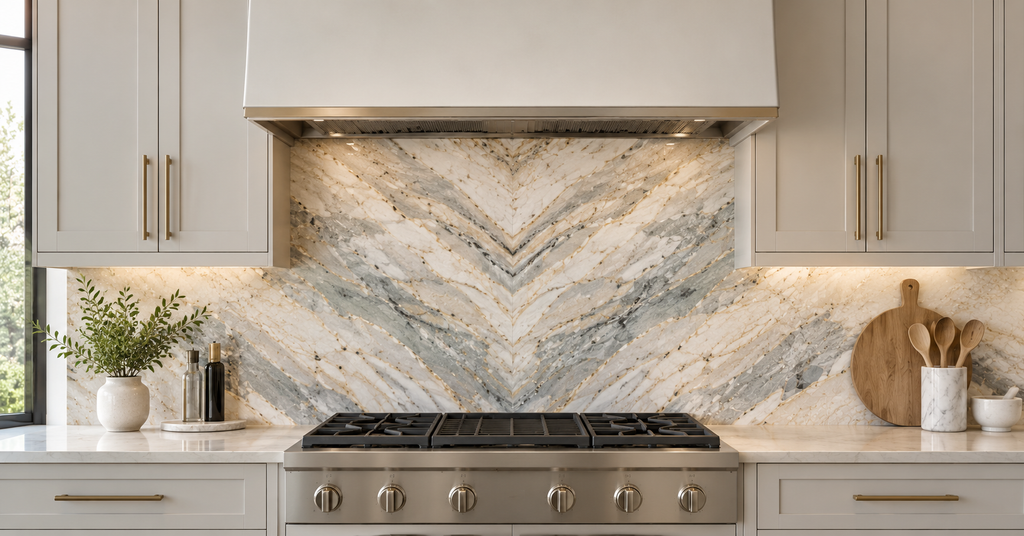
There’s a moment in a lot of kitchen and bathroom renovations where someone sees a photo online — usually a dramatic marble island or a floor-to-ceiling stone fireplace — and asks, “how did they do that?” The veins in the stone are perfectly mirrored, flowing from one slab to the next like a butterfly’s wings. It looks intentional. Almost sculptural.
That effect is called bookmatching, and it’s one of the most striking things you can do with natural stone. It’s also one of the most misunderstood, partly because it sounds more complicated than it is, and partly because most people don’t know they can ask for it until they’ve already seen a finished project and wished they had.
This guide covers everything: what bookmatching actually is, which applications it works best in, which stones are right for it, and exactly what to say when you walk into a showroom.
What Is Bookmatched Stone?
Bookmatched stone is created by slicing two consecutive slabs from the same block of stone and opening them like the pages of a book, so the veining on each slab mirrors the other perfectly.
When a block of natural stone comes out of a quarry, it gets cut into sequential slabs, each one revealing the next layer of the stone’s interior. Two slabs cut back to back from the same block will have nearly identical veining patterns, just reversed. When those two slabs are installed side by side with the seam running down the middle, the veins flow outward from the center in a symmetrical, mirror-image pattern.
The name comes from exactly what it looks like: opening a book. If you imagine a book lying flat and then opening it spine-up, the two pages face each other in a mirror. That’s the same principle. The seam where the slabs meet becomes the spine, and the veining unfolds outward from it.
This is fundamentally different from simply using two pieces of the same stone type. Stone from the same quarry or even the same batch will share a general color family, but the veining patterns will be completely different from slab to slab. True bookmatching requires consecutive slabs from the same block, and it requires planning — you can’t decide to bookmatch after the fact.
What Does Bookmatched Stone Actually Look Like?
The effect ranges from subtle and symmetrical to dramatically bold, depending on the stone’s veining. High-movement stones like Calacatta marble or quartzite create the most striking results, while quieter stones produce a softer, more textural effect.
In a Calacatta marble with thick, sweeping gold and gray veins, bookmatching produces a pattern that feels almost like a Rorschach test — bold, symmetrical, and impossible to ignore. In a more understated stone like a soft white quartzite with delicate gray veining, the effect is quieter: a gentle symmetry that adds depth and rhythm without demanding attention.
The look also depends heavily on where the bookmatched slabs are installed. Horizontal applications like kitchen islands display the mirrored pattern at eye level as you look down at the surface. Vertical applications — fireplace surrounds, full-height backsplashes, feature walls — show the effect at full height and tend to produce the most dramatic results. Waterfall edges, where the countertop material folds down the side of an island, are another favorite bookmatching application because the mirroring continues around the corner.
When Should You Use Bookmatched Stone?
Bookmatch when you want a surface to be a focal point, an island, fireplace, statement wall, or vanity that you want people to notice and remember.
Bookmatching works best when the installation is large enough to show off the full pattern, and when the stone has enough movement to make the mirroring visible and interesting. A tiny 24-inch vanity top in a half-bath won’t show off the effect the way a 10-foot island or a floor-to-ceiling fireplace surround will.
Here are the applications where bookmatching tends to deliver the best results:
Kitchen islands. A bookmatched island is arguably the most common and most impactful use of the technique in residential design. The horizontal viewing angle lets you appreciate the full symmetry of the pattern, and the island’s prominence in an open-plan kitchen means it reads as artwork as much as countertop.
Fireplace surrounds. Floor-to-ceiling stone around a fireplace is one of the most dramatic canvases in any home. Bookmatching here creates a formal, architectural symmetry that works in everything from modern minimalist living rooms to traditional great rooms.
Full-height backsplashes. When the same stone runs from the countertop all the way up to the range hood or ceiling, bookmatching the slab behind the range creates a centerpiece for the entire kitchen wall.
Bathroom feature walls and vanities. In a primary bathroom, a bookmatched wall behind a freestanding tub or a double-sink vanity turns a utilitarian space into something genuinely memorable. The symmetry works especially well in rooms designed around a central axis.
Waterfall countertop edges. A waterfall island with bookmatched slabs means the pattern wraps around the side of the island — the veining on the top slab mirrors the veining on the side panel, creating a continuous flow around the corner.
Which Stones Work Best for Bookmatching?
High-movement stones with bold, dramatic veining, like Calacatta marble, quartzite, and certain granites, produce the most striking bookmatched results. Low-movement stones can also be bookmatched but create a subtler effect.
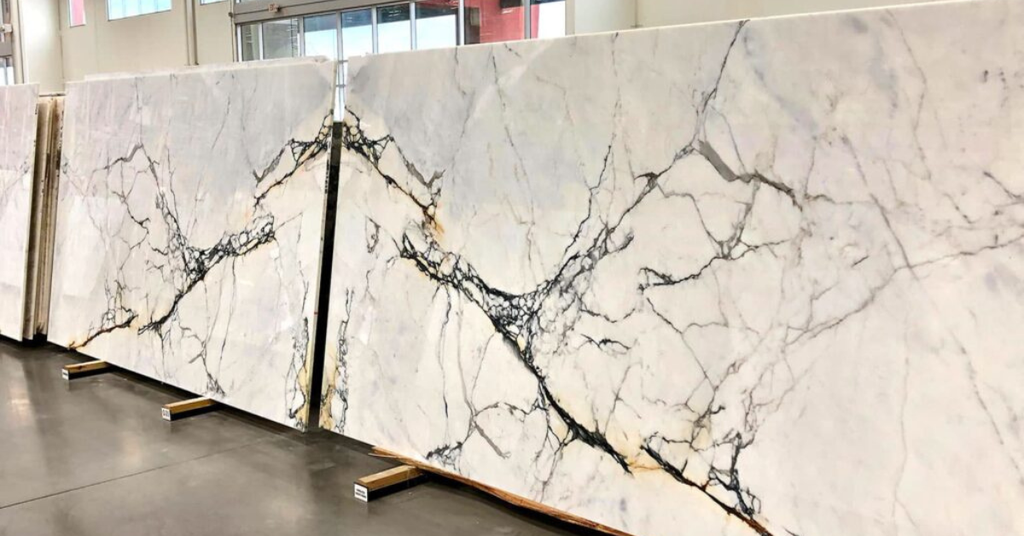
The more dramatic the veining in a stone, the more dramatic the bookmatched result will be. Calacatta marble is the classic choice: its thick, expressive veins in warm gold and gray create mirror patterns that look almost painted. Quartzite varieties with heavy movement, Super White, Taj Mahal, Cristallo, produce similarly bold results with the added benefit of greater durability.
Granite works well for bookmatching too, particularly varieties with visible movement rather than a uniform speckled pattern. A granite like River White or Fantasy Brown, which has flowing gray and taupe veining rather than a tight grain, will bookmatch beautifully. A very consistent, fine-grained granite like Absolute Black won’t produce a visible mirror effect simply because there isn’t enough variation in the pattern to reflect.
Porcelain slabs, the large-format engineered panels that mimic natural stone, can also be bookmatched. Because they’re manufactured, the pattern is fully repeatable, which means bookmatching porcelain is more predictable than natural stone. The tradeoff is that it lacks the genuine one-of-a-kind quality that makes natural stone bookmatching so special.
Does Bookmatched Stone Cost More?
Yes, bookmatching typically adds cost, primarily because it requires reserving two consecutive slabs from the same block, which limits how each slab can be used and increases the planning involved.
When a fabricator bookmatches stone, those two slabs have to be kept together and cut to work as a pair. That limits flexibility in how the material is used and means you’re essentially committing both slabs to a single installation, even if one slab would have been enough for the square footage. The planning, precision cutting, and careful seam alignment also add labor time.
The cost premium varies depending on the stone, the project size, and how much custom work is involved. For some projects, it’s modest, a few hundred dollars in additional labor. For a complex full-height fireplace surround with precision cuts, it can be more significant. The honest answer is that it depends on the project, which is why talking to your fabricator early, before you’ve made final material decisions, gives you the clearest picture of what you’re working with.
How Do You Ask for Bookmatched Stone at a Showroom?
Tell your fabricator you’re interested in bookmatching before you select your slab, ask to see consecutive pairs from the same block, and confirm the orientation and seam placement as part of the planning process.
The most important thing to know is that bookmatching is a planning conversation, not an afterthought. If you fall in love with a single slab and buy it without asking about its pair, that opportunity is gone. When you’re at the showroom and you see a stone you love, especially a high-movement marble or quartzite, ask these questions:
“Is there a bookmatched pair available for this slab?” Not every slab in stock will have its pair on hand, but a good showroom will either have it or be able to source it. At Masters Countertops, we can pull consecutive slabs from the same block and let you see both together before you commit.
“Can I see how they’d look opened up?” Standing two slabs next to each other and photographing them side by side gives you a preview of the finished effect. It takes a few minutes and removes all the guesswork.
“Where should the seam go?” The seam placement, where the two slabs meet, is one of the most important design decisions in a bookmatched installation. On an island, it typically runs down the center. On a fireplace surround, it usually aligns with the centerline of the firebox. Talk through seam placement with your fabricator before installation is scheduled.
“What orientation makes the most sense?” Slabs can be bookmatched horizontally or vertically. The orientation changes how the pattern reads. Your fabricator should be able to show you both options using photos or by positioning the slabs.
At Masters Countertops, we have the equipment and experience to make bookmatching straightforward, including the ability to match vein patterns precisely at the seam so the transition is seamless rather than just symmetrical.
Can You Bookmatch Quartz Countertops?
Yes, and Masters Quartz, our in-house quartz brand, carries slabs specifically designed to make bookmatching possible and strikingly beautiful.
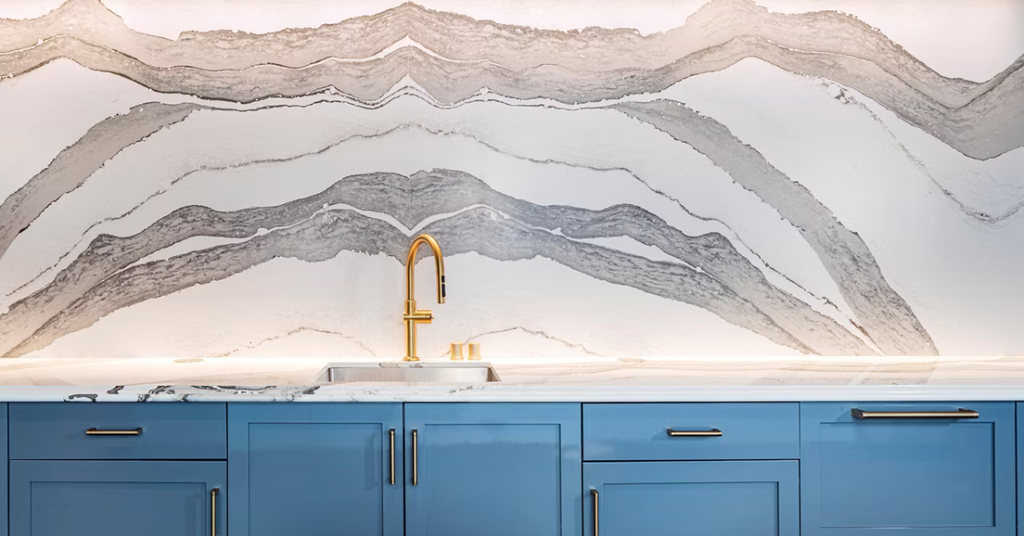
Most standard engineered quartz is produced with a consistent, repeating pattern that looks the same from slab to slab. Bookmatching two identical slabs simply gives you two identical slabs, there’s no mirror effect to achieve. But a growing segment of the quartz market has moved toward high-movement, natural stone-inspired designs that do lend themselves to bookmatching, and that’s exactly what our Masters Quartz line was built around.
Here are three Masters Quartz slabs currently in stock at our Wheeling showroom that work beautifully as bookmatched pairs:
Calacatta Roma brings a bright white base with elegant, flowing gray veining accented by subtle gold undertones. Its organic movement is exactly the kind of pattern that reveals itself beautifully when mirrored veins fan outward from the seam in a way that looks intentional and architectural rather than accidental. It’s a strong choice for a kitchen island or a full-height backsplash behind a range.
Magnolia takes a softer approach, with a crisp white-gray base layered with delicate, feathering veins in warm taupe and soft gray. Bookmatched, the feathering creates a symmetrical, almost botanical pattern calm and elevated rather than dramatic. It’s particularly well-suited to bathroom vanities or spa-style primary baths where the goal is quiet luxury rather than bold contrast.
Ocean Gold is the boldest of the three: a cool white base with branching, golden-amber veining and a natural shimmer that catches the light. When bookmatched, those branching veins mirror each other across the seam like a starburst, creating one of the most striking visual effects available in any quartz format. It’s an exceptional choice for a waterfall island or a fireplace surround where the goal is a true showpiece.
The practical advantage of bookmatching quartz versus natural stone is consistency. Because the veining is engineered rather than geological, the mirror effect at the seam is highly precise, what you see when the slabs are propped up side by side in the showroom is very close to what gets installed. For homeowners who want the visual drama of bookmatching with the durability and zero-maintenance reputation of quartz, these slabs offer a compelling path to that result.
Come see them in person at our Wheeling showroom. Our team can pull both slabs of a pair, position them side by side, and walk you through seam placement and orientation before you commit to anything.
See Bookmatched Stone in Person
Bookmatching is one of those things that photographs well but looks completely different when you’re standing in front of two full slabs. The scale, the movement, the way light plays across the stone at different times of day, none of that comes through on a screen.
If you’re considering a kitchen island, fireplace surround, bathroom feature wall, or any application where you want the stone to make a statement, come see what’s available in person. Our team at Masters Countertops can pull consecutive slab pairs, walk you through the bookmatching process, and help you plan seam placement and orientation so the finished result looks exactly the way you’re picturing it.
Use our Instant Quote tool to get a project estimate sent to your inbox, or stop by our showroom to see slabs in person.
Masters Countertops 363 Alice Street, Wheeling, IL 60090 Monday–Friday 9am–5pm | Saturday 9am–3pm masterscountertops.com
Like what you see? Follow us for more design inspiration, expert tips, and the latest trends in natural stone and quartz countertops. Don’t forget to share!