

Dark Countertops: Everything You Need to Know Before Going Bold
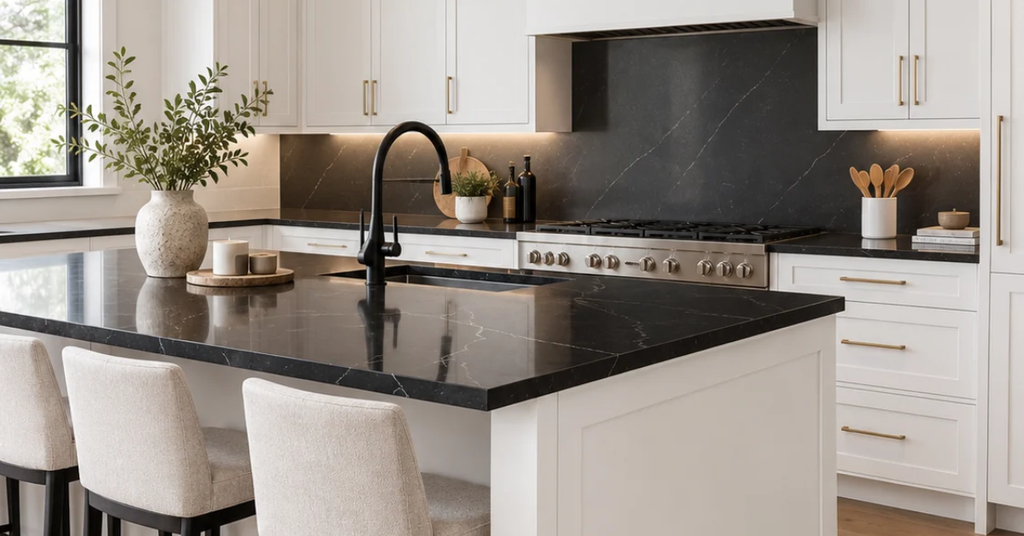
Dark countertops have a pull that’s hard to explain until you see them in person. There’s something about a deep black, rich charcoal, or moody dark green surface that makes a kitchen feel finished in a way lighter countertops rarely achieve. They photograph beautifully, they pair with almost any cabinet color, and they have a way of making a space feel intentional rather than accidental.
But they also come with real, practical considerations that lighter countertops don’t. But they also come with real, practical considerations that lighter countertops don’t. Fingerprints show more easily on dark surfaces. Watermarks can linger after every glass or pot. And depending on the material and finish you choose, scratches can be more or less visible which means the wrong combination for your kitchen can turn a bold design choice into a daily frustration.
So before you commit, here’s everything you actually need to know, the good, the realistic, and the decisions that will make the difference between a dark countertop you love and one you’re just tolerating.
Are Dark Countertops a Good Idea?
For the right kitchen, dark countertops are an excellent choice, dramatic, versatile, and timeless. The key is matching the material and finish to how you actually use your kitchen.
Dark countertops have been popular in high-end kitchen design for decades, and they’re not going anywhere. Unlike some trends that feel dated after five years, very dark surfaces, especially in black granite, dark quartz, or soapstone, have a classic quality that holds up over time. They work in contemporary kitchens, transitional designs, traditional spaces with dark wood cabinetry, and even bright, all-white kitchens where they serve as a grounding contrast.
The “good idea” question really comes down to two things: your material choice and your maintenance expectations. A dark honed granite in a busy family kitchen with three kids is a very different experience than a polished black quartz in a kitchen used mostly for weekend entertaining. Neither is wrong, but they require different approaches, and knowing the difference before you choose saves a lot of frustration down the road.
What Are the Best Materials for Dark Countertops?
Dark granite, quartz, quartzite, and soapstone are the most popular choices, each with different durability profiles, maintenance requirements, and visual characteristics.
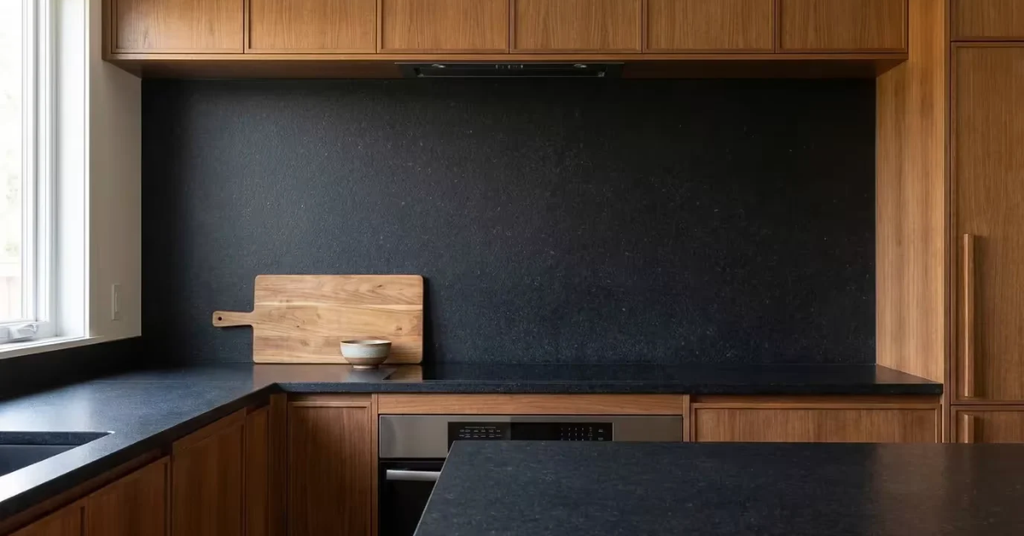
Dark Granite is one of the most durable countertop materials available, and it comes in some of the most striking dark colorways — Absolute Black, Black Pearl, and Ubatuba being perennial favorites. Granite is heat-resistant, scratch-resistant, and when properly sealed, handles stains well. The tradeoff is that it does require periodic sealing (typically every 1 to 3 years depending on the stone’s density) and the natural variation in the stone means no two slabs look exactly alike. For dark granite specifically, that variation tends to be subtle — flecks of silver, green, or brown within a dark background — which adds depth rather than chaos.
Dark Quartz is the low-maintenance alternative. Engineered quartz is non-porous, never needs sealing, and is highly resistant to staining and scratching. Dark quartz options like Black Meridian give you the bold look with significantly less upkeep. The tradeoff is that quartz can be damaged by prolonged heat exposure, always use trivets, and in very dark colorways, surface scratches can sometimes be more visible than on lighter quartz because the scratch disrupts the uniform color.
Dark Quartzite sits between marble and granite in terms of durability and is one of the most beautiful options in the dark category. Lemurian Blue, Black Forest, and Fantasy Brown (in its darker expressions) bring genuine natural stone drama, flowing veining, depth, and movement, with better durability than marble. It does require sealing and is heavier than quartz, which can matter for larger installations.
Soapstone is the quieter option in the dark category, available in deep charcoal and muted gray-black tones. It’s non-porous and naturally resistant to bacteria and staining, which makes it surprisingly practical. It does scratch and dent more easily than granite or quartzite but many homeowners come to appreciate that the surface develops a patina over time, and minor scratches can be sanded out with mineral oil. It’s a material with personality, not a maintenance problem.
Do Dark Countertops Show Fingerprints and Watermarks?
Yes, dark countertops show fingerprints and watermarks more visibly than lighter surfaces, and the finish you choose has a bigger impact on this than the color itself.
This is the most common concern we hear from buyers considering dark countertops, and it deserves a direct answer: yes, they do show more. A dark polished surface will reveal every fingerprint, water spot, and smudge in a way that a white or cream countertop simply won’t. This isn’t a defect, it’s physics. Light-colored surfaces scatter and diffuse light in a way that obscures marks; dark surfaces absorb light and make surface variations more visible.
The good news is that finish makes an enormous difference. A honed (matte) finish on a dark surface dramatically reduces the visibility of fingerprints and watermarks compared to a polished finish. The surface absorbs light rather than reflecting it, which means smudges don’t catch the light the same way. Many buyers who are concerned about maintenance choose dark honed countertops specifically because they offer the bold look without the constant wiping that a polished dark surface can require.
A leathered finish, a textured matte that’s becoming increasingly popular, is even more forgiving. The subtle texture breaks up the reflection further, hides minor marks, and adds a tactile quality that makes the surface feel distinctly different from standard polished stone.
Do Dark Countertops Make a Kitchen Feel Smaller?
Not necessarily, dark countertops can make a kitchen feel more grounded and defined rather than smaller, especially when paired thoughtfully with lighting and cabinetry.
The “dark makes rooms feel small” rule is more relevant to walls and floors than countertops. A dark countertop is a horizontal surface that your eye travels across rather than a surrounding element that closes in on you. In practice, dark countertops tend to visually anchor a kitchen, they give the space a clear, defined lower plane that can actually make the room feel more intentional and complete.
Where dark countertops can make a kitchen feel cramped is in spaces with limited natural light and dark cabinetry on every surface simultaneously. A small galley kitchen with dark lower cabinets, dark uppers, and dark countertops, and no windows, can feel heavy. The fix is contrast: light upper cabinets or open shelving, under-cabinet lighting, and adequate overhead lighting go a long way toward keeping a dark countertop from overwhelming a space.
In open-concept kitchens, dark countertops are almost always striking without feeling claustrophobic. The visual weight of the surface reads as sophisticated against the larger context of the open plan.
What Cabinet Colors Work Best With Dark Countertops?
White and light gray cabinets create the sharpest contrast, while natural wood tones add warmth, and two-tone designs with dark lowers and light uppers offer the most balanced approach.
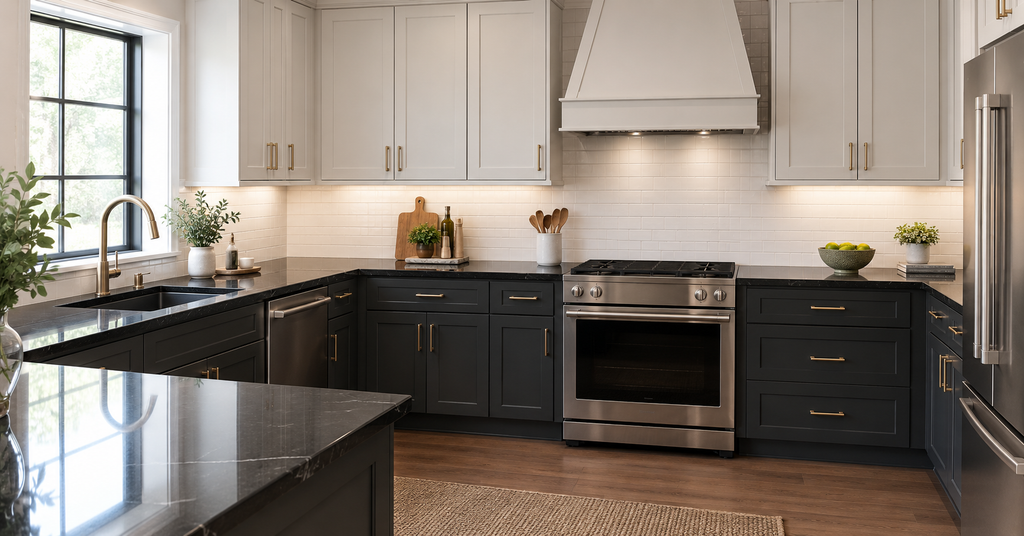
The pairing that tends to produce the most visually satisfying result is dark countertop on white or very light cabinets, it’s a classic contrast that feels clean, modern, and timeless without being trendy. The countertop becomes the focal point, the cabinets recede, and the hardware (brushed gold, matte black, polished nickel) bridges the two.
Natural wood cabinetry, white oak, walnut, or even a warm maple, pairs beautifully with dark countertops because the wood’s warmth keeps the dark surface from feeling cold or severe. This combination tends to land in transitional or Scandinavian-inspired kitchens and has real staying power as a design choice.
Two-tone kitchens, dark lower cabinets, light upper cabinets, work particularly well with dark countertops because the countertop color pulls from and reinforces the lower cabinet’s tone while the light uppers keep the overall palette balanced. It’s a design approach that gives you the boldness of a dark surface without committing every element of the kitchen to the same weight.
What to avoid: pairing very dark countertops with very dark cabinetry in a kitchen without strong lighting. It can work, but it requires very intentional lighting design to prevent the space from feeling like a cave rather than a dramatic, moody kitchen.
What Should You Look for When Choosing a Dark Countertop Slab?
See the full slab in person, pay attention to veining and movement across the whole surface, and decide on finish, polished, honed, or leathered, before you fall in love with a material.
Dark slabs have a way of looking very different at sample-chip size versus full slab. A chip of Absolute Black granite tells you almost nothing about how a 10-foot island will read in your kitchen. A chip of a veined dark quartzite tells you the color but nothing about how the veins distribute across the full surface, whether they’re evenly spread or concentrated, whether the pattern feels balanced or chaotic at scale.
This is why seeing full slabs in person matters so much with dark materials. The veining distribution, the shimmer of mineral flecks under different lighting, the way a honed versus polished finish changes the entire mood of the stone, none of that comes through on a screen or in a small sample.
When you’re standing in front of a slab, ask yourself: does the movement in this stone feel balanced across the whole surface? Does the finish I’m considering work with how my kitchen is lit? If I’m doing a waterfall edge, how will the veining look wrapping around the corner?
See Dark Countertops in Person at Masters Countertops
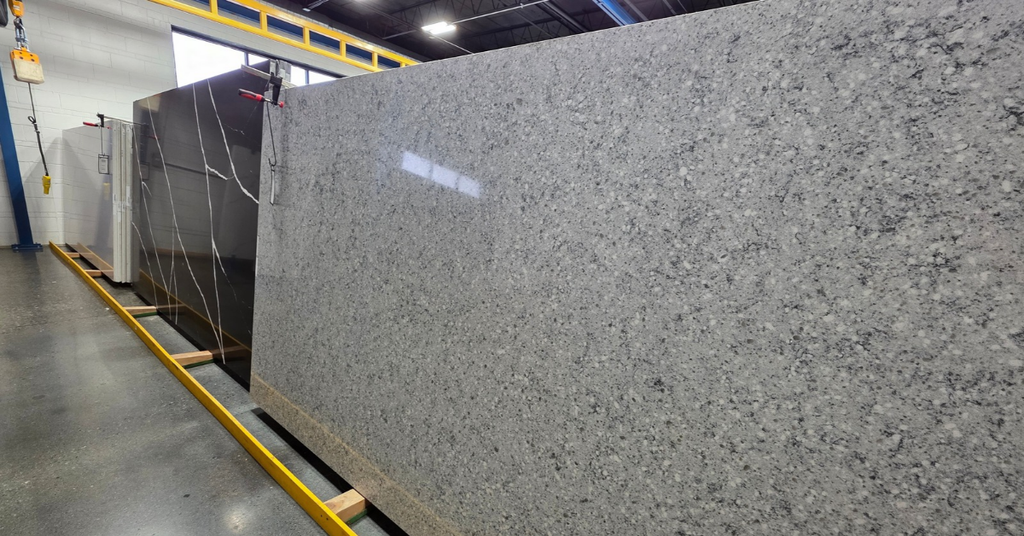
Choosing a dark countertop from a photo or a small chip is one of the most common mistakes buyers make and one of the most regrettable. The depth, the finish, the way light moves across a dark slab at different times of day, it all changes completely at full scale.
At Masters Countertops in Wheeling, IL, we carry granite, quartz, and marble slabs in stock so you can see them under real lighting, compare finishes side by side, and get a true sense of how a slab will look in your kitchen before you commit. Our team can walk you through material options, maintenance expectations, and design pairings based on your specific space.
Use our Instant Quote tool to get a project estimate sent to your inbox, or book a showroom visit to see our dark slab selection in person.
Masters Countertops 363 Alice Street, Wheeling, IL 60090 Monday–Friday 9am–5pm | Saturday 9am–3pm masterscountertops.com
Like what you see? Follow us for more design inspiration, expert tips, and the latest trends in natural stone and quartz countertops. Don’t forget to share!